
This blog post was written by: Jean Yong, Estate and Trust Consultant, Scotiatrust Toronto
One of the most common things I hear from clients is, “I don’t think my estate is that complicated.”
What they’re often really telling me is, “I don’t have enough money for estate planning to matter.”
It’s an understandable assumption. When we hear the term complex estate, we tend to picture multiple properties, private corporations, substantial investment portfolios or assets across different jurisdictions.
But after working with clients on estate planning, I’ve often found that assumption doesn’t hold true.
In fact, some of the most time-consuming and emotionally challenging estates I’ve encountered haven’t been the largest. At the same time, I’ve seen estates worth several million dollars that were relatively straightforward to administer.
The difference wasn’t the value of the assets. It was everything surrounding them.
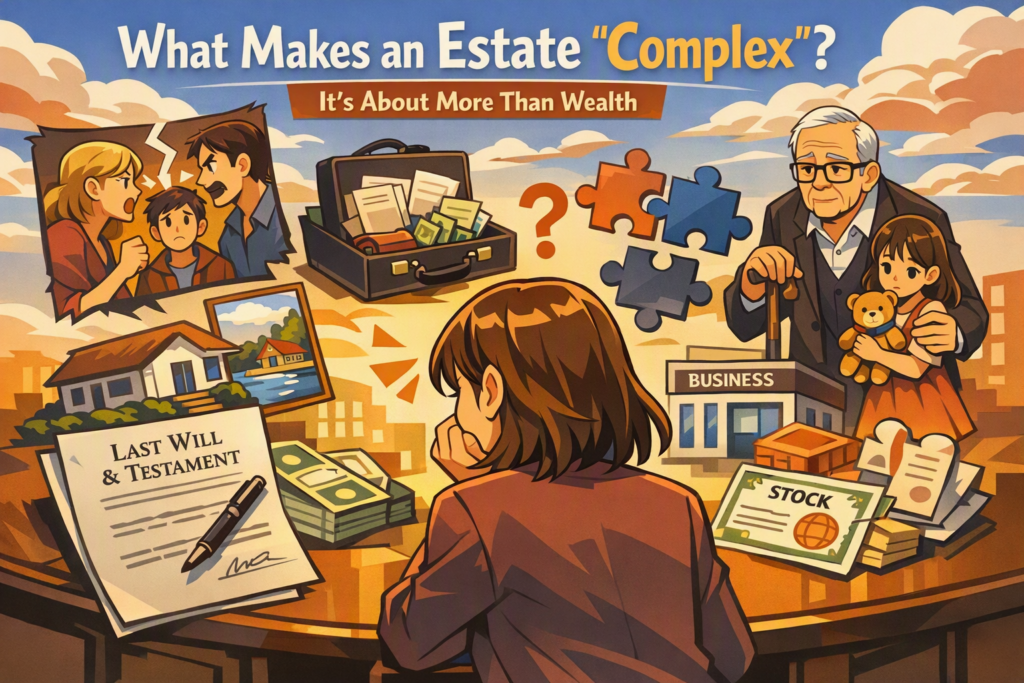
Family dynamics. Unclear wishes. Aging executors. Business interests. Vulnerable beneficiaries. Outdated planning. These are often the issues that create the greatest complexity and not the number of zeros on a balance sheet.
That’s why I don’t think complexity should be measured by the size of an estate. More often, it’s measured by the number of important decisions that still need to be made after someone can no longer make them.
And that’s also why I think so many people underestimate the importance of estate planning. If you’ve always thought, “My estate is pretty average,” you may also assume your planning can wait or that it doesn’t really apply to you. In my experience, it’s often those everyday lives and evolving family circumstances that benefit the most from thoughtful planning.
Questions usually begin to surface long before they involve money.
Why was one child appointed as executor? Was an equal distribution really intended? What happens now that the family has changed since the Will was signed? Did Mom want the cottage to stay in the family, or did everyone simply assume that?
Those questions rarely arise because an estate is worth more. They arise because life has become more complicated than the documents intended to reflect it.
Families today are more diverse than ever. Blended families, second marriages, beneficiaries who may require ongoing support, loved ones living in different provinces or countries and aging parents all bring planning considerations that may not have existed when an estate plan was first prepared.
Business ownership and cross-border assets can add another layer. So can planning for incapacity, which is often overlooked until it’s urgently needed. Choosing an attorney under a Power of Attorney isn’t simply about selecting someone trustworthy, it’s about ensuring they’re still willing, able and the right person to step into that role if the time comes.
I’ve also found that some of the most thoughtful estate plans can become the most complex, not because they’re poorly drafted, but because they’re trying to accomplish something meaningful.
Preserving a family cottage, providing for a second spouse while protecting an inheritance for children from a previous relationship, supporting a vulnerable beneficiary or leaving a charitable legacy can all require planning that reflects a family’s unique circumstances.
That’s why I encourage clients to think less about whether their estate is “large enough” to justify reviewing their plan and more about whether their life has changed since those documents were prepared.
Has your family changed? Has your business evolved? Has your chosen executor aged or moved away? Have your priorities shifted?
Those are the questions that reveal complexity, not the value shown on a financial statement.
Because even if you think of yourself as having a modest estate, there’s nothing modest about the life you’ve built or the people who matter most to you. Estate planning isn’t reserved for extraordinary wealth. It’s for anyone who wants to leave their loved ones with clarity instead of uncertainty.
