
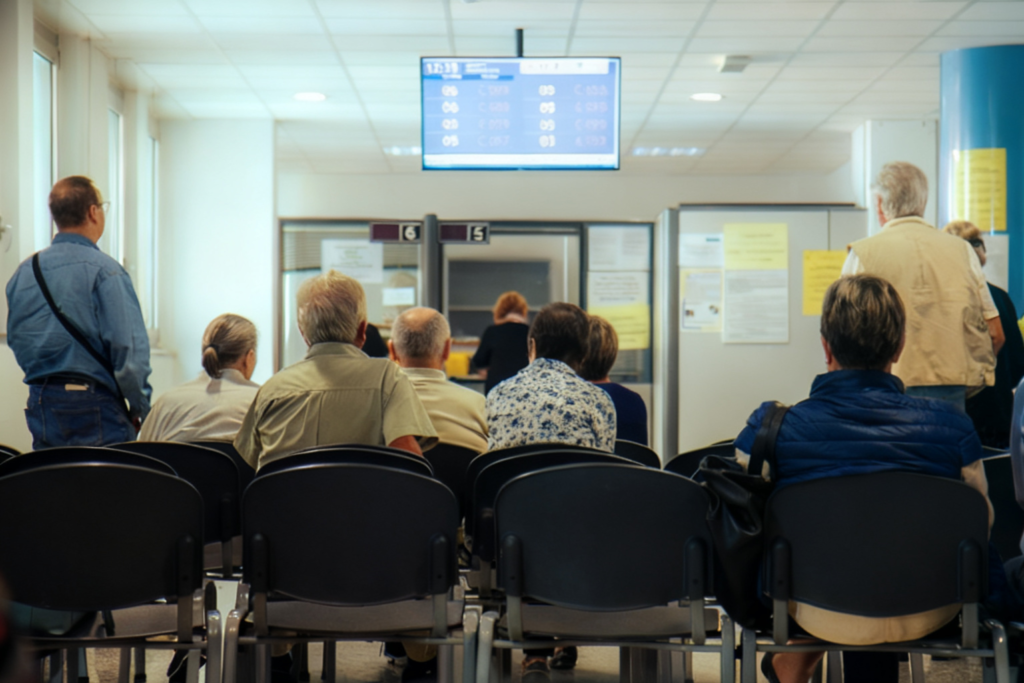
Emergency room physicians across Canada are ringing alarm bells about the continuing crisis in hospital emergency room (ER) wait times. For older Canadians, the emergency department is the main way they receive urgent care and for admission to a hospital bed. In its June 2026 report, the Canadian Institute for Health Information (CIHI) documents, discusses, and provides insights into the ER wait-time crisis and its causes. Many older clients may need to visit emergency rooms, so it is prudent to prepare families and caregivers for the reality they will face in today’s emergency rooms.
The Four Factors Driving Rising Wait Times
The CIHI report examines four sets of complex factors that drive rising wait times.
1. System-wide pressures
Compared with other OECD countries, Canada has fewer hospital beds per capita, higher hospital occupancy rates, and lower use of long-term care beds for older people. Workforce trends are showing a significant shortage of health care workers, and a shift of health care providers away from long-term care. In addition, the Personal Support Worker (PSW) workforce is struggling with increased burnout, low pay and benefits, and heavy workloads leading to shortages in both long-term care facilities and in the home care sector.
2. Patient acuity
Over the past 7 years, the report notes that high-acuity ER visits increased from 59% to 66% of all visits.
Almost a third (32%) of evisits in 2024–2025 were for patients with multiple comorbidities (concurrent medical conditions or illnesses such as hypertension, diabetes, and digestive complaints).
There is a common misconception that patients with non-emergency conditions are inundating the ERs and contributing to the crisis. However, the CIHI report suggests this is not the case, with about two-thirds of emergency room patients requiring immediate or urgent medical care.
3. Patient and system factors
In 2024–2025, half of ED patients spent four hours or less in the ED, and over a third spent five to 14 hours there. One in 10 spent over 14 hours there, representing a 28% increase from 2018–2019. Most ED visits (88%) ended in discharge, and among these patients, nearly nine in 10 spent less than 10 hours receiving care and treatment.
About 12% of ED visits resulted in hospital admission. These patients experienced markedly longer stays in the ED. In 2024–2025, half of admitted patients spent less than 16 hours waiting for transfer to an inpatient acute care bed, while one in 10 admitted patients spent almost two days or more in the ED.
Long waits for inpatient beds indicate that hospital resources are operating at or near capacity, creating further bottlenecks in the ER departments.
4. Availability of long-term care beds and community support
According to the Ontario Long-Term Care Association, there are an estimated 50,000 people in Ontario on the current waiting list for long-term care beds that meet the admission criteria. This is another bottleneck in the system; patients linger in an acute care bed because they cannot transition quickly to a long-term care bed.
Integrated community care and support are another key factor for older people. If an elderly person cannot go home without additional care support, and there is no integrated community support system in place, then they too will stay in an acute care hospital awaiting a solution for discharge.
Preparing Families & Caregivers for Long Wait Times
Many older clients may need emergency room care, so it is prudent to prepare families and caregivers for the current reality of exceptionally long waits. The following are suggestions for preparing.
- Determine if an ER visit is required. Could the issue be addressed by a family doctor, a nurse practitioner, or another provider? For example, Trillium Health Partners in Mississauga publishes a helpful guide outlining less serious conditions, such as sprains or urinary tract infections, that can be treated at their Queensway Urgent Care Centre rather than at one of their Emergency Departments.
- Check the emergency room dashboard on your local hospital’s website for its current wait times. ER-Watch Ontario is another website tracking hospital ER wait times across the province. However, the data often tracks only 40 or 50 of the 180 hospitals.
- Be prepared and bring important information with you.
- Current medication list including over-the-counter supplements.
- Written summary of your up-to-date health information, such as allergies, recent test results, contact information for primary health care provider, etc.
- Private insurance or health benefits card
- For an elderly person with dementia, an emergency room can be particularly difficult. The Alzheimer Society of Canada has an excellent tool to help caregivers prepare for an ER visit.
Solving the emergency room wait-times crisis in Canada will not be an easy or quick fix due to the complexities of the health system and multifactorial causes. Many older clients with multiple comorbidities may need emergency room care, so it is prudent to prepare families and caregivers for the current reality. Active planning for an emergency visit can assist with a better outcome for everyone.
